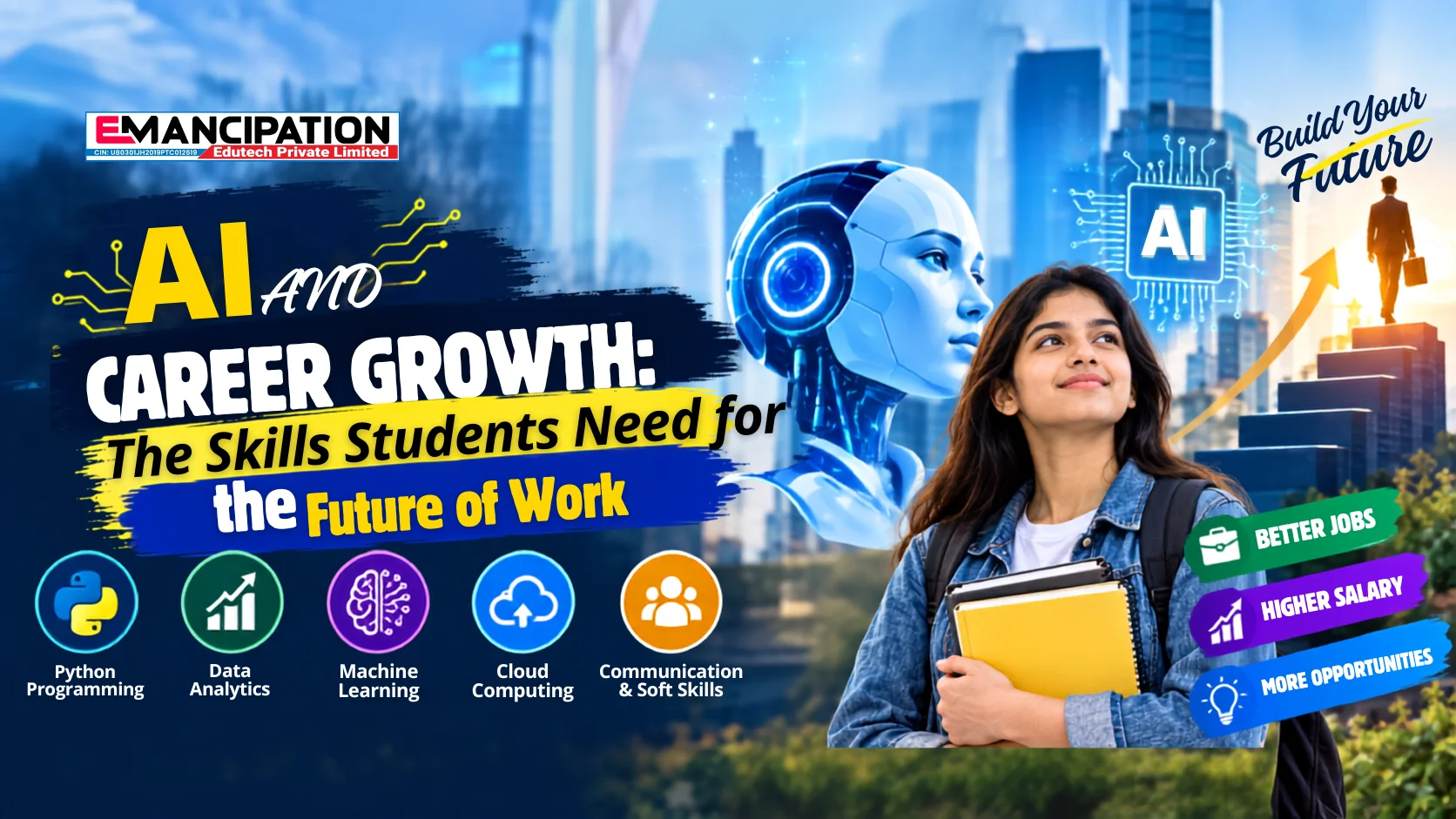
AI and Career Growth: The Skills Students Need for the Future of Work
AI is changing entry-level jobs, but students who combine technical skills, AI literacy, Data Analytics, communication and practical experience can adapt to the changing job market. Discover the skills Ranchi and Jharkhand students should learn to become job-ready and build stronger career opportunities.
If you are a college student or recent graduate, you have probably seen the headlines:
“AI will take millions of jobs.”
Then you open LinkedIn and see companies hiring for AI, data, software, automation and digital roles.
So which one is it?
Will AI replace freshers, or will it create new opportunities for them?
The honest answer is more complicated than either extreme.
AI is already changing entry-level work. Some repetitive tasks that once gave freshers their first opportunity are increasingly being automated. At the same time, companies still need people who can understand problems, work with AI, verify its output, communicate with customers and teammates, and turn technology into useful business results.
The World Economic Forum's Future of Jobs Report 2025 expects AI and big data to be among the fastest-growing skill areas, while analytical thinking, creativity, resilience, collaboration and technological literacy remain important human capabilities.
So the real question isn't:
“How do I compete with AI?”
It is:
“How do I become the person who knows how to use AI well?”
Will AI Replace Freshers or Just Change Fresher Jobs?
Think of AI as a very fast assistant.
A smart one, admittedly. One that never asks for tea breaks.
But it still needs someone to tell it what the actual problem is, check its work and decide what should happen next.
A student who only knows how to perform repetitive tasks may face more competition from automation. A student who can use AI, understand technology, analyze information and make sensible decisions becomes much more useful.
The distinction is important.
From Task Executor to Judgment Maker
Suppose a company needs a sales report.
Earlier, a fresher might spend hours collecting data, calculating figures and preparing the report.
Today, AI and automation can speed up several of those steps.
But someone still needs to ask:
Is the data correct?
Why did sales fall?
Which product performed best?
Is the AI's interpretation reasonable?
What should the company do next?
How should the findings be explained to the manager?
The work hasn't necessarily disappeared.
The valuable part of the work has moved upward.
This is why students shouldn't prepare to compete with AI at doing repetitive tasks faster.
They should learn how to work with AI while bringing judgment that the tool cannot reliably provide on its own.
The WEF's research is consistent with this broader shift: analytical thinking remains a core employer skill, while AI and big data are among the fastest-growing skill areas.
Why Freshers Still Matter in the AI Era
If companies can automate more work, why would they hire fresh graduates?
Because businesses don't only need today's workers.
They need people who can grow into tomorrow's workforce.
Fresh Perspectives Matter
A fresher may not have years of industry experience, but they can bring something else: familiarity with newer technologies and a willingness to experiment.
Students who are already comfortable with AI tools can help teams discover faster ways of researching, coding, analyzing data and creating content.
Companies Need People Behind the Technology
AI can generate output.
It doesn't automatically understand the company's customer, internal politics, business goals or local market.
Someone has to connect the technology to the actual problem.
That's where domain knowledge + AI skills becomes powerful.
Entry-Level Jobs Are Evolving
The WEF expects technology-related roles such as AI and machine learning specialists, big data specialists and software/application developers to be among the fastest-growing roles through 2030. At the same time, some clerical and data-entry roles are expected to decline.
For students, the lesson isn't “AI is taking all the jobs.”
It is:
Don't build your entire career around tasks that technology can easily automate.
The AI-Ready Skill Stack for Freshers
So what should a student actually learn?
You don't need 27 certificates and a LinkedIn headline that looks like a programming language.
You need a useful combination of technical and human skills.
1. Learn Core Programming Fundamentals
AI can write code.
You should still learn how code works.
For students interested in IT careers, useful foundations can include:
Python
Java
C/C++
Programming logic
Data structures
Databases
SQL
APIs
Git and GitHub
Why?
Because when AI generates code, you need to know whether that code is correct.
You should be able to debug it.
You should be able to change it.
And, ideally, you should understand what you are submitting before confidently saying:
“Yes sir, the code works.”
2. Build Data Analytics Skills
Data is becoming part of almost every modern business.
That makes data literacy useful even if you don't plan to become a full-time data scientist.
Students can start with:
Excel
SQL
Data cleaning
Data visualization
Power BI
Python for data analysis
Basic statistics
Business interpretation
Don't just learn how to make a colourful dashboard.
Learn how to answer:
“What does this data actually tell us?”
That is the difference between operating a tool and thinking like an analyst.
https://emancipation.in/course/data-analytics-course-in-ranchi
3. Understand AI and Machine Learning Fundamentals
You don't have to become an AI researcher on day one.
Start with the basics.
Understand:
What AI is
What machine learning is
How datasets are used
What training means
What models do
What prediction means
What bias and data quality problems are
Where AI can fail
Students with a programming background can gradually move toward Python + Machine Learning + Data Analytics + AI tools.
The WEF expects AI and big data skills to grow rapidly in importance, making AI literacy increasingly relevant across careers.
https://emancipation.in/course/machine-learning-course-in-ranchi
4. Learn Practical AI Literacy
Knowing that ChatGPT exists isn't an AI skill.
Knowing how to use it properly is more useful.
Students should learn how to use tools such as:
ChatGPT
Microsoft Copilot
GitHub Copilot
Cursor
Other AI research and productivity tools
Learn Prompt Engineering
A weak prompt might be:
“Write Python code.”
A useful prompt could specify:
The problem
Input format
Expected output
Constraints
Programming language
Error handling
Examples
That's closer to giving instructions to a junior assistant.
And remember:
Never blindly trust AI-generated code or information.
Check it.
Test it.
Question it.
5. Develop the Human Skills AI Can't Simply Hand You
Here's where many technically strong students underestimate themselves.
You can know Python.
You can know SQL.
You can know AI.
And still struggle to get hired if you can't communicate what you know.
Communication
Learn to explain your work without turning every sentence into technical soup.
Spoken English
For students who want to work with national or international teams, improving spoken English can make interviews, presentations and workplace conversations easier.
You don't need an artificial accent.
You need clarity and confidence.
Critical Thinking
AI can produce an impressive-looking answer that is completely wrong.
Learn to verify.
Interview Skills
Practice answering:
Tell me about yourself.
Explain your project.
Why should we hire you?
What did you learn from your project?
What happens if your code fails?
How did you use AI?
Your interviewer isn't only testing whether you memorized syntax.
They're testing whether you understand what you're talking about.
Why Hands-On Learning Matters for Students in Ranchi
For many students in Ranchi and Jharkhand, the challenge isn't lack of ambition.
It is the gap between learning something theoretically and actually being able to use it.
A student may pass a semester exam in programming and still struggle to build a small application.
Someone may watch 40 hours of a data analytics course and still not know how to analyze a messy Excel dataset.
Someone may complete an AI tutorial but freeze when asked:
“Show me something you built.”
That gap matters.
Theory Is Not the Same as Practical Skill
College education provides an important foundation.
But students often need additional hands-on practice to become comfortable with real tools and projects.
For example, knowing the definition of SQL is one thing.
Writing queries against an actual database is another.
Knowing Python syntax is one thing.
Using Python to solve a real data problem is another.
Employers ultimately need people who can apply knowledge.
Why Hands-On Training in Ranchi Can Help
Students who prefer classroom learning can benefit from a structured environment where they can practise, ask questions and work through problems with faculty.
This can be particularly useful for students who feel they understand theory but struggle to convert it into practical work.
The objective shouldn't be to replace college education.
It should be to add practical skills to the degree you already have.
Emancipation Ranchi: Combining Technical Skills With Career Preparation
Students in Ranchi looking for practical technology training can explore Emancipation Ranchi, located at Abhinandan Complex, Tharpakhna, near Plaza Chowk and Women's Polytechnic, Ranchi.
Emancipation's training approach is positioned around practical skill development rather than only classroom theory.
For students considering a local institute, the focus areas include technical courses alongside communication and career-development support.
Practice-First Learning
Instead of stopping at theoretical explanations, students can work toward applying concepts through projects and practical exercises.
For a fresher, this matters.
Because eventually someone is going to ask:
“What have you built?”
You need an answer.
Technical Skills + Communication Skills
One useful aspect of a job-ready approach is combining technical training with communication development.
Emancipation offers training areas including:
Data Analytics
Machine Learning
Python
Java
Full-Stack Development
Other computer and technology skills
Students can also work on Spoken English and Personality Development, helping address a common gap between technical knowledge and interview performance.
The goal is not simply to know technology.
It's to be able to explain and use it confidently.
Mentorship and Doubt Resolution
Learning programming can sometimes feel like arguing with your laptop.
One missing bracket and suddenly your entire afternoon has disappeared.
Having faculty support and one-to-one doubt resolution can help students identify where they are going wrong instead of repeatedly watching the same tutorial.
For beginners especially, timely feedback can prevent small misunderstandings from becoming bigger learning gaps.
Affordable and Flexible Learning
For students comparing institutes in Ranchi, course fees and payment flexibility are practical considerations.
Emancipation provides course options with affordable fee structures and flexible installment/EMI options, subject to the course and current institute terms.
Students should always confirm the latest fees, schedule and payment options directly with the institute before enrolling.
Career Guidance, Resume and Placement Support
Learning a technical skill is only one part of becoming job-ready.
Students also need to know how to present that skill.
Career-oriented support can include:
Resume building
Interview preparation
Career guidance
Project guidance
Placement support
Communication development
This creates a more complete preparation process for students who are moving from college toward their first job.
Which Skills Should a Ranchi Student Prioritize?
It depends on your career goal.
If you want a software development career:
Focus on:
Programming → Python/Java → DSA → Databases → Git → Projects → AI-assisted development
If you are interested in Data Analytics:
Focus on:
Excel → SQL → Power BI → Python → Data Analysis → Projects
Students searching for a Python and Data Analytics course in Ranchi should look for programs that include substantial practical work rather than only lectures.
https://emancipation.in/course/data-analytics-course-in-ranchi
If you want AI/ML:
Start with:
Python → Mathematics & Statistics basics → Data Analytics → Machine Learning → AI projects
If you're searching for places to learn AI in Ranchi, check whether the course teaches fundamentals and projects rather than simply teaching students how to use a few AI websites.
https://emancipation.in/course/python-course-in-ranchi
If communication is your weak point:
Add:
Spoken English → Interview practice → Presentation → Workplace communication
Technical knowledge gets you into the conversation.
Communication helps you participate in it.
https://emancipation.in/course/spoken-english-mastery
A Simple Job-Ready Roadmap for Students
You don't need to learn everything simultaneously.
Try this approach.
Step 1: Pick One Career Direction
Don't learn Python, Java, cybersecurity, digital marketing, AI, animation and six other things at the same time.
Choose one starting point.
Step 2: Build Fundamentals
Understand the basics before relying heavily on AI.
Step 3: Add AI
Use AI to research, practise, debug, automate and learn.
But verify its output.
Step 4: Build Real Projects
Create things that solve actual problems.
A project doesn't need to change the world.
A useful student project is enough.
Step 5: Improve Communication
Practise explaining your project in simple language.
If you cannot explain it without reading your own README file, you probably need to understand it better.
Step 6: Prepare for Interviews
Practise technical questions, HR questions and project discussions.
Step 7: Build Your Proof of Work
Use:
GitHub
Resume
LinkedIn
Portfolio
Project demonstrations
Your goal is to move from:
“I completed a course.”
to:
“Here is what I built.”
So, Will AI Replace Freshers?
Some entry-level tasks will disappear.
Some jobs will change.
New roles will emerge.
And many existing jobs will become AI-assisted rather than purely human.
The students most exposed to disruption are likely to be those whose entire value comes from completing repetitive tasks.
The students building a combination of technical skills, AI literacy, analytical thinking, domain knowledge and communication are preparing for a different kind of workplace.
The goal isn't to become “AI-proof.”
That's impossible.
The goal is to become AI-capable.
Learn how the technology works.
Use it.
Question it.
Improve its output.
And most importantly, learn how to solve problems that actually matter.
Because the future workplace probably won't ask:
“Can you work without AI?”
It may ask:
“What can you accomplish with AI that you couldn't accomplish before?”
That's the question students should start preparing to answer.
To know everything about jobs in IT sector : https://emancipation.in/blog/it-sector-jobs-in-india-demand-future-scope-and-careers
Frequently Asked Questions
Will AI eliminate coding jobs for freshers?
AI can automate parts of software development, including some repetitive coding and documentation tasks. However, software roles still require problem-solving, system understanding, debugging, security awareness, communication and product context. Students who learn programming fundamentals and use AI as a development assistant can prepare for this changing environment.
Can non-CS students learn AI and Data Science in Ranchi?
Yes. Students from non-CS backgrounds can begin with foundational programming, mathematics, statistics and data skills before progressing toward AI and Machine Learning. The right starting level depends on your existing knowledge, so beginners should look for courses that don't assume advanced programming experience.
What are the best job-ready skills for students in Ranchi?
There isn't one skill that guarantees a job. Depending on your career goal, useful combinations can include Python, Java, SQL, Excel, Data Analytics, Machine Learning, AI tools, communication, critical thinking and project development.
How does Emancipation help freshers become job-ready?
Emancipation Ranchi focuses on practical technical training alongside areas such as Spoken English, Personality Development and career preparation. Its stated support areas include practical projects, faculty guidance, doubt resolution, resume building, career guidance and placement support. Students should confirm the latest course structure and placement terms directly with the institute.
Ready to Build Your AI-Ready Career in Ranchi?
You don't need to know exactly what the job market will look like five years from now.
You need skills that allow you to adapt when it changes.
If you're a BCA student, BTech student, graduate, fresher or career switcher in Ranchi, start building your technical and communication skills before you need them.
Explore Emancipation Ranchi, visit the Plaza Chowk/Tharpakhna area branch near Women's Polytechnic, and ask about a free demo class and the latest course options.
Don't wait for your first interview to discover that your degree was only the starting point.
Build the skills now. Build the projects. Build the confidence.
AI is changing the rules.
Your job is to learn how to play the new game.
If this article helped you rethink your career preparation, share it with a friend who is worried about AI and fresher jobs.
For More Information and Updates, Connect With Us
- Phone Number: +919264477176, +917488456170
- Blogs: https://emancipation.in/blog
- Our Platforms:
- YouTube: https://www.youtube.com/@Emancipation.Edutech
- Live Emancipation: https://live.emancipation.co.in
- Follow Us on Social Media:
- Instagram - https://www.instagram.com/teamemancipation/
- Facebook - https://www.facebook.com/teamemancipation/
- Connect on Linkedin: https://in.linkedin.com/school/emancipation/