Why Graduates Struggle to Get Jobs: Skills Every Fresher Should Build
Many graduates struggle to find their first job despite having a degree. Discover the reasons behind this challenge, understand the gap between academic knowledge and workplace expectations, and explore essential practical, communication, and technical skills every fresher should develop.
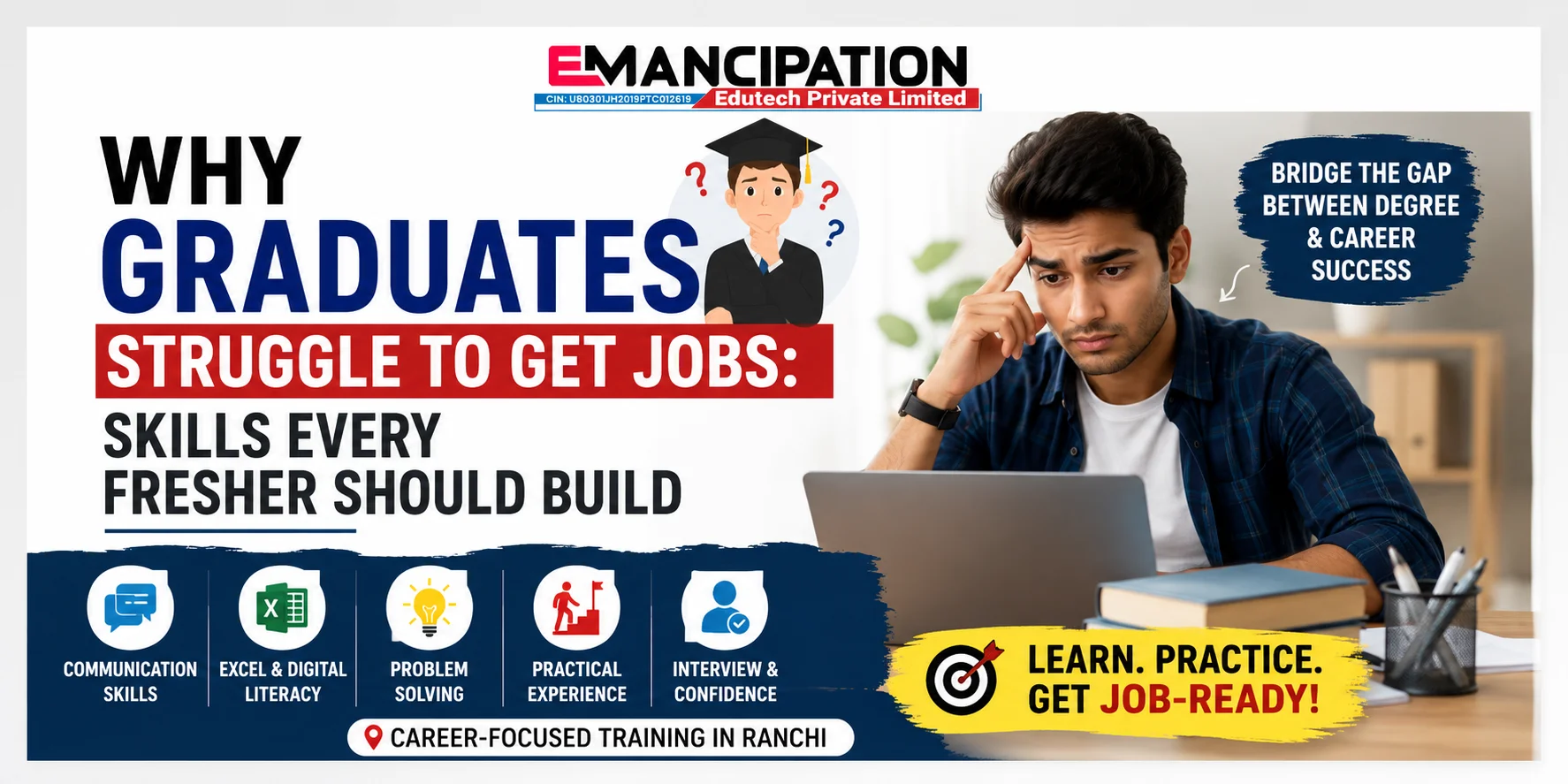
Completing a graduation degree is an important achievement, but for many students, the real challenge begins after college. Despite spending years studying, graduates often struggle to find their first job. They attend interviews, submit resumes, and apply for different positions, yet suitable opportunities can remain difficult to secure.
This situation is not always related to a lack of academic knowledge. Sometimes, the problem is the gap between what students learn in college and what employers expect in the workplace.
For graduates in Ranchi and other parts of Jharkhand, understanding this gap can be an important step towards building a successful career. A degree provides an educational foundation, but practical knowledge, communication, confidence, and professional skills also matter.
So, why do graduates struggle to get jobs, and what skills should every fresher develop before entering the professional world?
Why Do Many Graduates Struggle to Find Jobs?
Having a degree does not automatically mean someone is prepared for every workplace responsibility. Employers generally look for candidates who can understand instructions, complete assigned tasks, communicate clearly, and adapt to a professional environment.
Here are some common reasons fresh graduates face difficulties while searching for employment:
1. Lack of Practical Experience
Many students understand theoretical concepts but have limited experience applying them. For example, a commerce graduate may understand accounting principles but struggle to organise financial information in Excel. Similarly, a computer science graduate may know programming concepts but find it difficult to develop a complete working project.
2. Weak Communication Skills
Communication is important in almost every profession. Candidates need to explain their ideas, participate in discussions, write professional emails, and respond confidently during interviews.
3. Limited Computer Knowledge
Basic computer skills are useful across different industries. Employers may expect freshers to work with documents, spreadsheets, presentations, emails, and digital platforms. Students who have little practical experience with these tools may need additional preparation.
4. Poor Interview and Resume Preparation
Some graduates submit generic resumes without highlighting their actual skills or projects. Others struggle to answer basic interview questions about their education, strengths, and career interests.
5. Not Understanding Job Requirements
Applying for every available vacancy without checking its requirements can waste time. Freshers need to understand the skills expected for a particular role and prepare accordingly.
The Gap Between Academic Knowledge and Workplace Skills
Academic education and workplace learning serve different purposes. Colleges provide theoretical knowledge, subject understanding, and academic foundations. Professional environments require people to apply that knowledge to practical situations.
Consider a simple example. A student may learn spreadsheet formulas during college examinations. However, working with actual business data requires additional abilities, such as organising information, identifying errors, preparing reports, and presenting results.
This does not mean academic education is unimportant. A graduation degree can provide valuable subject knowledge and help students qualify for different opportunities. However, combining academic learning with practical experience can make candidates better prepared for entry-level responsibilities.
Freshers should therefore focus on developing skills that complement their educational qualifications.
Essential Skills Every Fresher Should Build
1. Communication and English-Speaking Skills
Freshers should learn to express their thoughts clearly, listen carefully, and communicate professionally. Practise speaking in English, participate in group discussions, and learn how to introduce yourself during interviews.
2. Basic Computer and Digital Literacy
Learn how to use computers confidently, manage files, work with internet tools, and handle common office applications. These abilities are useful in administrative, business, and technical roles.
3. MS Excel and Spreadsheet Management
Excel is widely used for organising information, maintaining records, preparing reports, and analysing data. Freshers should practise formulas, sorting, filtering, conditional formatting, and PivotTables.
4. Problem-Solving and Critical Thinking
Employers value people who can understand a problem and think of practical solutions. Students can develop these abilities through assignments, projects, case studies, and regular practice.
5. Interview and Presentation Skills
Knowing the answer is not enough if you cannot explain it confidently. Practise common interview questions, prepare a short self-introduction, and learn to present your projects.
6. Industry-Relevant Technical Skills
Choose technical skills according to your career interests. For example, aspiring data analysts can explore Excel, SQL, and Power BI, while students interested in software development can start with Python, Java, or other programming languages.
7. Resume Writing and Professional Behaviour
Your resume should clearly explain your education, technical abilities, projects, and relevant experience. Learn professional etiquette, punctuality, and workplace communication.
8. Adaptability and Continuous Learning
Technology and workplace requirements change. Freshers should remain open to learning new tools, accepting feedback, and improving their abilities over time.
Why Practical Experience Matters for Fresh Graduates
One common challenge for freshers is explaining what they can actually do. A resume may mention several skills, but employers may want examples that demonstrate those abilities.
Practical projects can help bridge this gap.
For example, a B.Com graduate can create an Excel-based sales report, while a BCA student can develop a simple Python application. A student interested in data analytics can prepare a dashboard using sample business data.
Other ways to gain practical experience include:
· Internships: Understand professional responsibilities and workplace expectations.
· Personal projects: Apply classroom knowledge to independent tasks.
· Real-world assignments: Practise solving problems using relevant tools.
· Portfolio development: Collect completed projects to demonstrate your abilities.
How Graduates Can Become More Job-Ready
Becoming job-ready is a gradual process. Instead of trying to learn everything together, follow a practical approach.
1. Identify your skill gaps: Understand which abilities you currently lack.
2. Choose a career direction: Explore roles that match your education and interests.
3. Learn relevant skills: Focus on tools and knowledge required for your chosen field.
4. Practise consistently: Spend time applying what you learn instead of only watching tutorials.
5. Build projects: Complete practical assignments that demonstrate your understanding.
6. Improve communication: Practise speaking, writing, and explaining your ideas.
7. Prepare your resume: Highlight relevant skills, projects, and educational qualifications.
8. Practise interviews: Research entry-level roles and prepare for commonly asked questions.
Why Choose Emancipation for Practical Skill Development in Ranchi?
Choosing the right training centre can help graduates follow a structured learning process. However, students should compare institutes based on practical exposure, trainer guidance, course content, and learning support rather than advertisements alone.
Emancipation Edutech Private Limited is a training centre located in Tharpakhna, Ranchi, offering different computer and professional learning programmes.
Its learning approach highlights project-led training, mentorship, and practical skill development. These are useful factors for graduates who want to strengthen their knowledge beyond classroom theory.
Students can explore different learning options depending on their interests:
· Data Analytics: Excel, SQL, Power BI, and data visualisation.
· Python Programming: Programming fundamentals and practical coding projects.
· Java Programming: Core and advanced programming concepts.
· C and C++: Programming fundamentals and logical thinking.
· Machine Learning and AI: An introduction to modern intelligent technologies.
· Computer Applications: Essential computer and office-related skills.
You can explore the computer and IT courses at Emancipation to understand the available programmes.
What Makes Emancipation Worth Considering?
When comparing computer training institutes in Ranchi, look beyond course certificates. Ask whether students get sufficient practical sessions, individual guidance, project opportunities, and support in understanding career options.
Emancipation highlights practical learning, experienced faculty, updated course content, and career guidance. Its focus on different learning areas also gives students opportunities to explore courses according to their educational backgrounds and interests.
Whether you are from BA, B.Com, B.Sc, BCA, or another academic background, choosing a suitable course should depend on your career goals and existing knowledge.
Students can visit the centre at:
Emancipation Edutech Private Limited
Abhinandan Complex, Tharpakhna, Near Government Women's Polytechnic,
Ranchi, Jharkhand – 834001.
For course details and guidance, visit the Emancipation website or contact the team.
Final Thoughts
Struggling to find a first job does not mean you lack ability or potential. It may simply mean that you need to strengthen certain skills and gain more practical experience.
For graduates in Ranchi, the next step is to identify what employers expect and start working towards those requirements. Learn consistently, practise regularly, and give yourself time to improve.
A successful career does not begin with knowing
everything. It begins with recognising what you need to learn and taking the
first step towards it.
FAQs
Q1. Why do graduates struggle to get jobs after completing their degrees?
Many graduates lack practical experience, communication skills, technical knowledge, and interview preparation. These gaps can make it difficult to meet the expectations of entry-level positions.
Q2. What skills should every fresher develop to get a job?
Freshers should develop communication, computer literacy, MS Excel, problem-solving, teamwork, time management, and industry-relevant technical skills.
Q3. Can graduates from non-IT backgrounds learn computer skills?
Yes. Graduates from BA, B.Com, BBA, and other backgrounds can start learning computer applications, Excel, programming, or data analytics according to their interests and career goals.
Q4. How can freshers gain practical experience without a job?
They can work on personal projects, complete practical assignments, participate in internships, volunteer, and build a portfolio demonstrating their abilities.
Q5. Where can graduates learn practical computer skills in Ranchi?
Graduates can explore computer and IT training programmes at Emancipation Edutech Private Limited, located in Tharpakhna, Ranchi.