High-Paying Computer Courses: Best Career Options for Students and Graduates
Looking for high-paying computer courses after graduation? Explore Data Analytics, AI and Machine Learning, Python, Full-Stack Development, Cloud Computing and Cybersecurity. Learn about career options, realistic salary expectations and how to choose the right computer training institute in Ranchi. Discover practical IT training and career guidance at Emancipation Edutech.
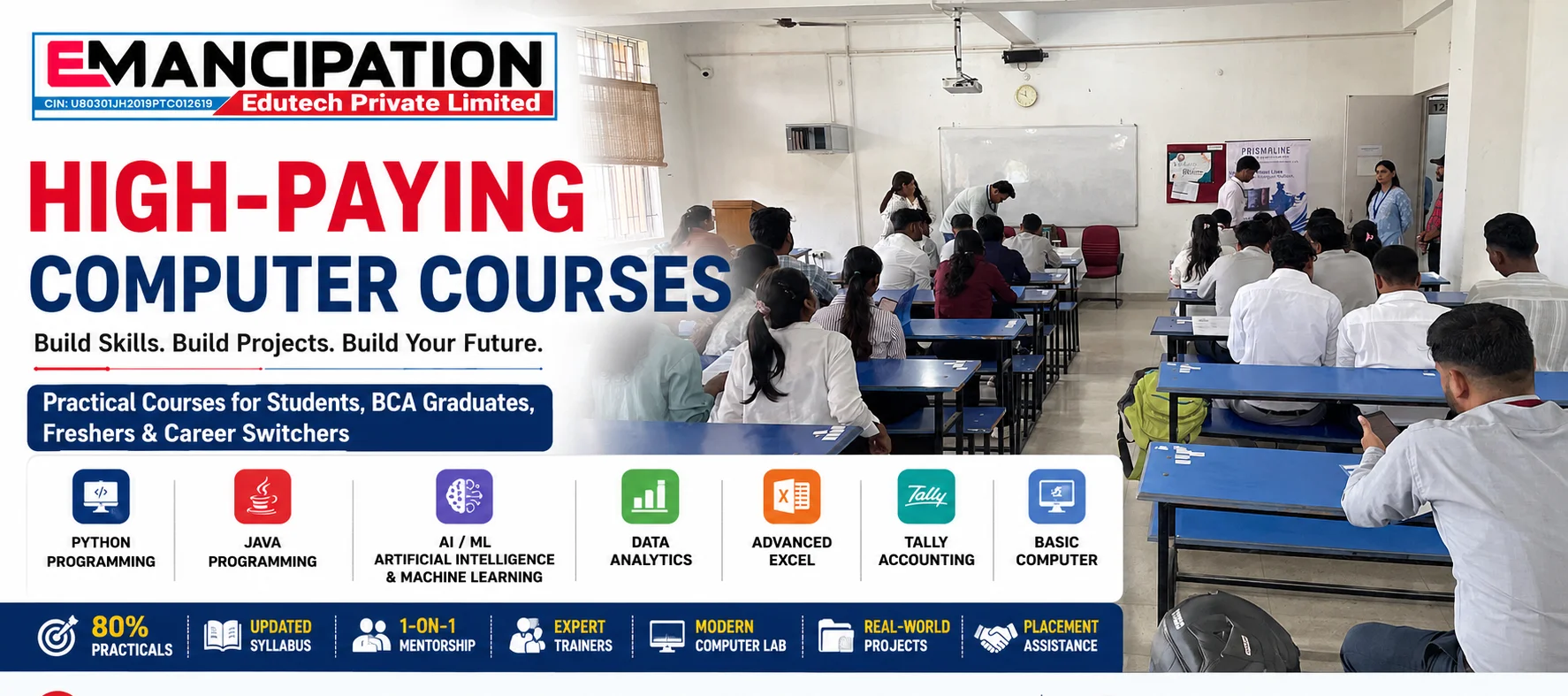
High-Paying Computer Courses: Best Career Options for Students and Graduates
Choosing the right computer course can make a big difference to your career. Whether you have completed Class 12, graduated with a BCA, B.Com, B.Sc. or B.A. degree, or are planning to switch careers, learning the right technical skills can help you explore better job opportunities.
Today, companies across industries use technology to manage information, understand customers, automate tasks, protect data and develop digital products. This has created opportunities for people with skills in data analytics, artificial intelligence, software development, cybersecurity, cloud computing and other areas of IT.
But with so many courses available, one question often comes up: Which computer course is best for a high-paying job?
The answer depends on your educational background, interests, existing skills and willingness to practise. A course with a popular name is not enough. You need to learn practical skills, work on projects and understand how to apply your knowledge in real situations.
In this guide, we will explore some of the best high-paying computer courses, the skills they teach, possible career opportunities, salary expectations and how to choose the right training institute in Ranchi.
Why Are Computer Courses Important for Career Growth?
A graduation degree provides an academic foundation, but many employers also look for practical knowledge and the ability to use industry-relevant tools.
For example, a graduate who knows how to prepare reports, analyse business data, write SQL queries or develop a working application may be better prepared for certain entry-level roles than someone who has only studied these topics theoretically.
Computer courses can help you:
Develop practical skills that are relevant to workplace requirements.
Explore career opportunities in IT and other technology-enabled industries.
Build projects that demonstrate your abilities to employers.
Improve your problem-solving and technical communication skills.
Prepare for internships, entry-level jobs or future specialisation.
Students in Ranchi and other parts of Jharkhand can begin by identifying the type of work they enjoy and choosing a course that matches their current skill level.
1. Data Analytics and Business Intelligence
Data Analytics is a useful career option for students who enjoy working with numbers, spreadsheets, reports and business information.
Businesses generate data through sales, customer transactions, websites, inventory systems and daily operations. Data analysts help organisations organise this information, identify patterns and make informed decisions.
What Will You Learn?
A practical Data Analytics course may include:
Advanced Microsoft Excel and data cleaning
Formulas, PivotTables and Power Query
SQL for retrieving information from databases
Power BI or Tableau for interactive dashboards
Basic statistics and data interpretation
Python for data analysis
Business reporting and project presentation
Career Opportunities
After developing the required skills, you can explore roles such as:
Junior Data Analyst
MIS Executive
Reporting Analyst
Business Intelligence Analyst
Junior Business Analyst
Who Should Choose Data Analytics?
This course is suitable for BCA, B.Com, B.Sc., B.A. and other graduates who are interested in reports, business problems and working with data.
You do not need to be an advanced mathematics student to begin learning basic analytics. Start with percentages, averages, ratios and charts, then gradually develop your statistical understanding.
For students who already know Excel, learning SQL and Power BI is a practical next step.
2. Artificial Intelligence and Machine Learning
Artificial Intelligence (AI) and Machine Learning (ML) are used in applications such as recommendation systems, fraud detection, language tools, image recognition and business automation.
These technologies offer interesting career opportunities, but they require more than knowing how to use AI tools. Building AI systems involves programming, data preparation, testing and an understanding of how models work.
What Will You Learn?
A structured AI and Machine Learning course may cover:
Python programming
Data structures and basic algorithms
Statistics and probability
Data preparation and analysis
Machine learning algorithms
Model evaluation
Deep learning and introductory neural networks
Generative AI concepts and practical applications
Career Opportunities
Depending on your skills and experience, you may work towards roles such as AI Engineer, Machine Learning Engineer, Junior ML Developer or AI Application Developer.
Who Should Choose AI and ML?
AI and ML are suitable for learners who enjoy programming and are willing to develop their mathematical foundations. Beginners should first learn Python and basic statistics before moving to advanced machine learning topics.
If mathematics is currently difficult for you, that does not mean you must avoid AI forever. It simply means you should build your foundation step by step instead of rushing into an advanced course.
3. Full-Stack Web Development
Web development is a practical option for students who want to build websites, web applications and digital products.
A full-stack developer works with both the front end, which users see, and the back end, which manages application logic, data and server-side operations.
What Will You Learn?
A full-stack development programme may include:
HTML and CSS
JavaScript
React or another front-end framework
Backend programming
Databases and APIs
Git and GitHub
Application testing and deployment
Career Opportunities
Possible career paths include Front-End Developer, Backend Developer, Full-Stack Developer and Junior Software Developer.
Who Should Choose This Course?
Choose web development if you enjoy coding, creating websites and solving technical problems. You should be prepared to write code regularly and build complete applications rather than simply watch tutorials.
A portfolio containing a working website, a database-driven application and a deployed project can help demonstrate your abilities during interviews.
4. Cloud Computing and DevOps
Modern businesses rely on cloud platforms to store information, run applications and manage their technology infrastructure. DevOps practices help development and operations teams automate software delivery and improve reliability.
Cloud computing and DevOps can be rewarding career paths, particularly for learners who enjoy systems, networking and automation.
What Will You Learn?
Depending on the programme, topics may include:
Linux fundamentals
Computer networking
AWS, Microsoft Azure or Google Cloud
Cloud storage and virtual machines
Docker and container basics
CI/CD pipelines
Infrastructure monitoring
Basic scripting and deployment
Career Opportunities
You may work towards roles such as Cloud Support Associate, Junior Cloud Engineer, DevOps Engineer or Site Reliability Engineer as your skills develop.
Who Should Choose Cloud Computing?
This course suits students who enjoy technical troubleshooting and understanding how computer systems work. Beginners should first learn operating systems, networking and Linux before moving to advanced cloud infrastructure.
Practical lab exercises are especially important because employers need people who can configure, troubleshoot and maintain systems.
5. Cybersecurity and Ethical Hacking
As organisations rely more heavily on digital systems, protecting information and networks has become an important responsibility.
Cybersecurity professionals help identify vulnerabilities, investigate suspicious activity, monitor systems and reduce security risks.
What Will You Learn?
A foundation-level cybersecurity course may cover:
Networking fundamentals
Linux and operating system basics
Security principles
Firewalls and access control
Vulnerability assessment
Security monitoring and SIEM tools
Incident response
Ethical penetration-testing fundamentals
Career Opportunities
Depending on your training and practical ability, you may pursue roles such as SOC Analyst, Junior Security Analyst or Security Operations Associate.
Who Should Choose Cybersecurity?
Cybersecurity is suitable for learners who enjoy investigation, technical problem-solving and understanding how systems can be protected.
Remember that ethical hacking must be performed only in authorised environments. Practical training should include legal lab exercises, not unauthorised access to real systems.
6. Python Programming
Python is widely used in automation, web development, data analysis and artificial intelligence. It is a useful starting point for graduates who want to enter a technical field but are not yet confident with programming.
What Will You Learn?
A good Python course should teach:
Variables and data types
Conditions and loops
Functions and modules
Lists, tuples, dictionaries and sets
File handling and exception handling
Object-oriented programming
Working with libraries
Practical programming exercises
Depending on your chosen specialisation, you can later learn Pandas for data analysis, Django or Flask for web development, or machine learning libraries for AI applications.
Career Opportunities
Python can support career paths such as Junior Python Developer, Automation Developer, Data Analyst or Backend Developer, depending on the additional skills you learn.
Who Should Choose Python?
Python is a good option for BCA students and other graduates who want to strengthen their programming foundation. You do not need to master every advanced concept immediately. Focus on writing small programmes, debugging errors and solving problems independently.
7. Java Programming and Software Development
Java remains an important programming language for enterprise applications, backend systems and various business software solutions.
Learning Java can help students understand object-oriented programming and prepare for software development roles.
What Will You Learn?
Java syntax and programming fundamentals
Object-oriented programming
Collections and exception handling
Data structures and algorithms
SQL and database connectivity
APIs and backend development
Spring Boot fundamentals, where included
Software testing and project development
Career Opportunities
Possible roles include Junior Java Developer, Software Developer and Backend Developer.
Java can be a suitable choice for BCA graduates who want to prepare for software development jobs or strengthen their programming knowledge before pursuing further education.
8. Software Testing and Test Automation
Not every technology career requires building an application from scratch. Software testing focuses on checking whether an application works correctly, identifying defects and helping teams deliver reliable software.
Test automation adds programming and specialised tools to make repetitive testing more efficient.
What Will You Learn?
A practical course may include:
Manual testing fundamentals
Test cases and test scenarios
Bug reporting and defect tracking
SQL basics
API testing
Python or Java fundamentals
Selenium or other automation tools
Regression testing and test reports
Career Opportunities
You can explore Junior QA Tester, Software Test Engineer and Automation Testing roles as your skills develop.
This path can suit learners who are detail-oriented and enjoy finding problems, testing different situations and improving software quality.
9. UI/UX Design
UI/UX design is another option for students who prefer creative problem-solving over intensive programming.
UI, or User Interface design, focuses on the visual elements of a digital product. UX, or User Experience design, focuses on how easily and effectively people can use it.
What Will You Learn?
Design principles and visual hierarchy
Wireframing and prototyping
Figma and interface design
User research fundamentals
User journeys and usability testing
Responsive design principles
Portfolio development
Career Opportunities
Possible roles include UI Designer, UX Designer and Junior Product Designer.
Students should build a portfolio that explains the design problem, the decisions they made and how their proposed solution improves the user experience.
10. Advanced Excel, Accounting Software and Office Applications
For students who want to develop workplace computer skills, Advanced Excel, MS Office and accounting software can also be valuable choices.
These skills are useful across administration, finance, operations, sales, reporting and business support functions.
What Will You Learn?
Depending on the course, you may study:
MS Word, Excel and PowerPoint
Advanced Excel formulas
PivotTables and data visualisation
Power Query and report preparation
Tally and accounting fundamentals
Business documentation
Data entry and office productivity
Career Opportunities
These skills can support applications for MIS Executive, Accounts Assistant, Office Executive, Data Entry Operator and Reporting Executive positions.
To improve your long-term prospects, combine basic office skills with a specialisation such as SQL, Power BI or accounting.
High-Paying Computer Courses Compared
The following table provides a practical overview of the main options.
| Course | Important skills | Suitable career paths |
|---|---|---|
| Data Analytics | Excel, SQL, Power BI, statistics | Data Analyst, BI Analyst |
| AI and Machine Learning | Python, statistics, ML | AI Engineer, ML Engineer |
| Full-Stack Development | JavaScript, backend, databases | Software Developer |
| Cloud and DevOps | Linux, cloud platforms, automation | Cloud Engineer, DevOps Engineer |
| Cybersecurity | Networking, security tools, monitoring | SOC Analyst, Security Analyst |
| Python Programming | Python, problem-solving, libraries | Python Developer, Automation Developer |
| Java Development | Java, OOP, databases | Java Developer, Backend Developer |
| Software Testing | Test design, SQL, automation | QA Engineer, Test Engineer |
| UI/UX Design | Figma, prototyping, usability | UI/UX Designer |
| Advanced Excel and Office | Excel, reporting, office tools | MIS Executive, Reporting Executive |
Salary Expectations After Completing a Computer Course
One of the most common questions students ask is how much they can earn after completing a computer course.
The answer depends on the role, the employer, your practical skills, location and interview performance. Course completion alone does not guarantee a particular salary.
The following are broad, indicative annual salary ranges for planning purposes, not guaranteed offers or official salary averages.
| Career path | Indicative salary range |
|---|---|
| MIS / Reporting Executive | ₹2–3.5 LPA |
| Junior Data Analyst | ₹2.5–5 LPA |
| Junior Software Developer | ₹3–6 LPA |
| Junior QA / Testing Professional | ₹3–5 LPA |
| Entry-Level Cloud Support | ₹3–6 LPA |
| Junior Cybersecurity Analyst | ₹3–6 LPA |
| AI / ML Entry-Level Roles | ₹4–8 LPA |
Some candidates receive higher offers, especially when they have strong projects, internships or specialised skills. Other freshers may start below these ranges.
For a realistic career plan, focus first on becoming employable. Gain experience, improve your technical depth and communication skills, and then target more specialised roles with stronger earning potential.
Which Computer Course Should You Choose After Graduation?
There is no single course that is best for every graduate. Your education, interests and current skills should guide your decision.
If You Have Completed BCA
You can explore Data Analytics, Python Programming, Java Development, Full-Stack Development, Cloud Computing or AI and Machine Learning.
If you are interested in further studies, building programming and database skills can also support your preparation for an MCA.
If You Have Completed B.Com or B.A.
Data Analytics, Advanced Excel, Business Intelligence, accounting software and digital business tools can be useful starting points. Your best option depends on whether you prefer business reporting, finance, technology or creative work.
If You Have Completed B.Sc.
Depending on your subject and interests, you can consider Data Analytics, Python, software development, cloud computing or AI and Machine Learning.
If You Are a Beginner With Weak Mathematics
Do not assume that every computer course requires advanced mathematics.
You can begin with Advanced Excel, basic SQL, reporting or web development. If you later want to study Data Science or Machine Learning, gradually build your statistics, probability and mathematical foundations.
If You Want to Get a Job as Soon as Possible
Choose a course with a manageable learning path and practical assignments. Build two or three good projects, prepare your resume and start applying for suitable internships or entry-level positions while continuing to learn.
Avoid choosing a course only because an advertisement promises a high salary or guaranteed placement.
How to Choose the Right Computer Training Institute in Ranchi
Choosing the right training institute is just as important as choosing the course.
Before enrolling, check whether the institute offers a structured curriculum, practical sessions, individual doubt-clearing support and projects relevant to your career goal.
Here are some important things to look for:
Practical training: You should spend time working with software, tools, datasets or programming exercises rather than only listening to lectures.
Experienced trainers: A good trainer explains concepts clearly, answers questions and helps students understand how to apply their knowledge.
Project-based learning: You should finish the course with work that demonstrates what you can do independently.
Updated course content: The curriculum should reflect current tools and workplace requirements.
Career guidance: Resume preparation, interview practice and job-search guidance can help you prepare for the transition from learning to employment.
Transparent course information: Ask about the syllabus, duration, fees, batch timings, certification and the type of support provided after training.
For students searching for a computer training institute in Ranchi, these factors are more useful than choosing a centre based only on advertisements or salary claims.
How Emancipation Helps Students Build Practical Computer Skills
At Emancipation Edutech Private Limited, Ranchi, our aim is to help students develop useful computer skills through structured training, practical learning and career guidance.
Students have different starting points. Some want to learn computers from the basics, while others have completed graduation and want to prepare for professional IT roles. The right learning path should match the student's existing knowledge and career objective.
Computer Courses Available at Emancipation
Emancipation offers computer and professional IT training options, including:
Data Analytics: Learn tools and techniques for data cleaning, analysis, reporting and dashboards, including Excel, SQL, Power BI and related analytics tools.
Machine Learning and AI: Build knowledge of Python, machine learning and related concepts through a structured learning path.
Python Programming: Develop programming fundamentals and practise solving problems with Python.
Java Programming: Learn Java concepts and develop a foundation for software development.
C and C++ Programming: Understand programming fundamentals, logic and object-oriented concepts.
Computer Applications: Explore courses such as DCA and ADCA to develop broader computer and office application skills.
Course availability, curriculum, duration and fees can vary by programme. Visit the official Emancipation website or contact the training centre for current details.
1. Learning That Goes Beyond Theory
Understanding a concept is only the first step. Students also need opportunities to practise.
For example, a Data Analytics learner should work with spreadsheets, clean datasets, write queries, create dashboards and explain what the results mean. A programming student should write code, solve errors and build applications.
Project-based learning helps students connect classroom concepts with practical tasks.
2. Guidance Based on Your Career Goals
Not every student needs to study AI or advanced programming immediately.
A student interested in business reports may benefit from Excel, SQL and Power BI. Someone who enjoys coding may prefer Python, Java or full-stack development. A beginner may need to build basic computer knowledge before moving to a professional course.
Emancipation's training team can help students explore suitable options based on their educational background and goals.
3. Personal Mentoring and Doubt-Clearing Support
Students learn at different speeds. Some understand a topic quickly, while others need additional practice.
Mentoring and doubt-clearing sessions can help learners identify gaps in their understanding, improve their confidence and work towards completing projects independently.
4. Practical Projects and Skill Development
Working on projects helps students demonstrate more than course attendance.
Depending on the selected programme, projects may involve building a dashboard, writing a Python application, developing a website or practising programming concepts.
These activities help students prepare examples they can discuss during interviews.
5. Career Guidance and Interview Preparation
Completing a course is an important milestone, but preparing for a job is a separate process.
Emancipation provides career guidance and placement-related support to help students prepare for opportunities. Students should ask about the specific support available for their chosen programme, including resume preparation, mock interviews and job-search assistance.
No training programme can guarantee a particular salary or job outcome for every student. Your preparation, performance and the opportunities available also matter.
Visit Emancipation Edutech in Ranchi
If you are looking for computer courses in Ranchi, you can contact Emancipation to discuss the available programmes and identify a suitable learning path.
Emancipation Edutech Private Limited
Abhinandan Complex, Tharpakhna, near Government Women's Polytechnic, Ranchi, Jharkhand – 834001.
Visit: https://emancipation.in/
Contact the team to ask about current course fees, syllabus, duration, batch availability and career guidance.
A Practical Roadmap to Start Your Career
If you are confused about where to begin, follow these steps.
Step 1: Identify your interests. Decide whether you enjoy data, coding, designing, networking or business applications.
Step 2: Check your current skill level. If you are new to computers, begin with the fundamentals. If you already know Excel or programming, build on that foundation.
Step 3: Select one main course. Avoid trying to learn AI, web development, cybersecurity and analytics all at once.
Step 4: Practise consistently. Spend time solving exercises and working on small projects every week.
Step 5: Build a portfolio. Keep your projects organised and prepare to explain the problems you solved.
Step 6: Prepare for interviews. Practise technical questions, resume writing, communication and explaining your project decisions.
Step 7: Apply for relevant opportunities. Explore internships, trainee roles and entry-level jobs while continuing to improve your skills.
A focused learning plan is often more effective than collecting several certificates without developing practical ability.
Frequently Asked Questions
Which computer course is best for a high-paying job?
AI and Machine Learning, Data Science, Cloud Computing, Cybersecurity and Software Development can offer strong earning potential. The right choice depends on your skills, interests and the effort you invest in practical learning.
Which computer course is best after graduation?
BCA graduates can explore Data Analytics, Python, Java, Full-Stack Development, Cloud Computing and AI. Graduates from other streams can consider Data Analytics, Advanced Excel, business applications or programming based on their interests and current knowledge.
Can I learn Data Analytics if my mathematics is weak?
Yes. You can begin with Excel, SQL, charts, percentages, averages and basic statistics. Advanced mathematics is not required for every entry-level analytics task, although deeper statistical knowledge becomes important for specialised fields such as Data Science and Machine Learning.
How long does it take to learn a computer course?
The duration depends on the subject, your starting level and the time you practise. You may develop foundational skills in a few months, but becoming job-ready requires practical projects, interview preparation and continued learning. Ask the institute for the specific duration and syllabus of your chosen programme.
Which computer course is suitable for beginners?
Advanced Excel, basic computer applications, Python fundamentals and introductory web development can all be starting points. Choose according to your career goal rather than simply selecting the easiest course.
Does Emancipation provide computer training in Ranchi?
Yes. Emancipation Edutech offers computer and IT training options, including Data Analytics, Machine Learning, Python, Java, C and C++, and computer application courses. Check the official website or contact the centre for current programme details.
Does completing a computer course guarantee a job?
No course can guarantee a job or a particular salary for every student. Practical skills, projects, communication, interview performance and employer requirements all influence hiring outcomes. Career guidance and placement-related support can help students prepare for opportunities.
Final Thoughts
The best computer course is not necessarily the one with the highest advertised salary. It is the course that matches your interests, builds useful skills and gives you opportunities to practise what you learn.
If you enjoy working with data, start with Excel, SQL and Power BI. If you prefer programming, explore Python, Java or Full-Stack Development. If you are interested in infrastructure or security, build a foundation in networking, Linux and cloud or cybersecurity concepts before moving to advanced topics.
For students and graduates in Ranchi and across Jharkhand, the first step is to choose a clear career direction and start learning consistently.
Ready to explore your options? Visit Emancipation.in or contact Emancipation Edutech Private Limited in Ranchi to discuss available computer courses, practical training and career guidance.
Your career can start with one well-chosen course, consistent practice and the willingness to keep learning.