Concept Learning in Machine Learning: Algorithms, Examples & Career Opportunities
Concept Learning in Machine Learning helps computers learn patterns and identify concepts from labelled examples. Explore how concept learning works, understand popular algorithms like Find-S and Candidate Elimination, discover practical applications, and learn about career opportunities in AI and Machine Learning.
Concept Learning in Machine Learning: Algorithms, Examples & Career Opportunities
Machine learning is changing how computers understand information, recognise patterns and make decisions. From identifying unwanted emails to helping businesses understand customer behaviour, machine learning has become an important part of modern technology. But have you ever wondered how a computer learns to recognise something from different examples?
This is where concept learning in machine learning becomes important.
Concept learning is one of the basic ideas behind machine learning. It helps a computer learn a particular concept by studying examples and finding common patterns. Understanding this topic can help students build a strong foundation in artificial intelligence, data science and machine learning.
In this guide, we will explain what concept learning means, how it works, its important algorithms, practical examples and the career opportunities available in the machine learning field.
What Is Concept Learning in Machine Learning?
Concept learning is the process through which a machine learns a general rule or concept by studying labelled training examples.
In simple words, the computer observes different examples, identifies their common features and creates a rule to decide whether new information belongs to a particular category.
For instance, imagine teaching a computer to identify different types of fruits. You provide information about fruits, including their colour, shape and size, along with their correct labels. After studying these examples, the computer tries to understand which features belong to a particular category.
The main purpose of concept learning is to help a machine understand a target concept and apply what it has learned to new examples.
Concept learning is an important foundation of supervised learning because it uses labelled data to learn patterns.
How Does Concept Learning Work?
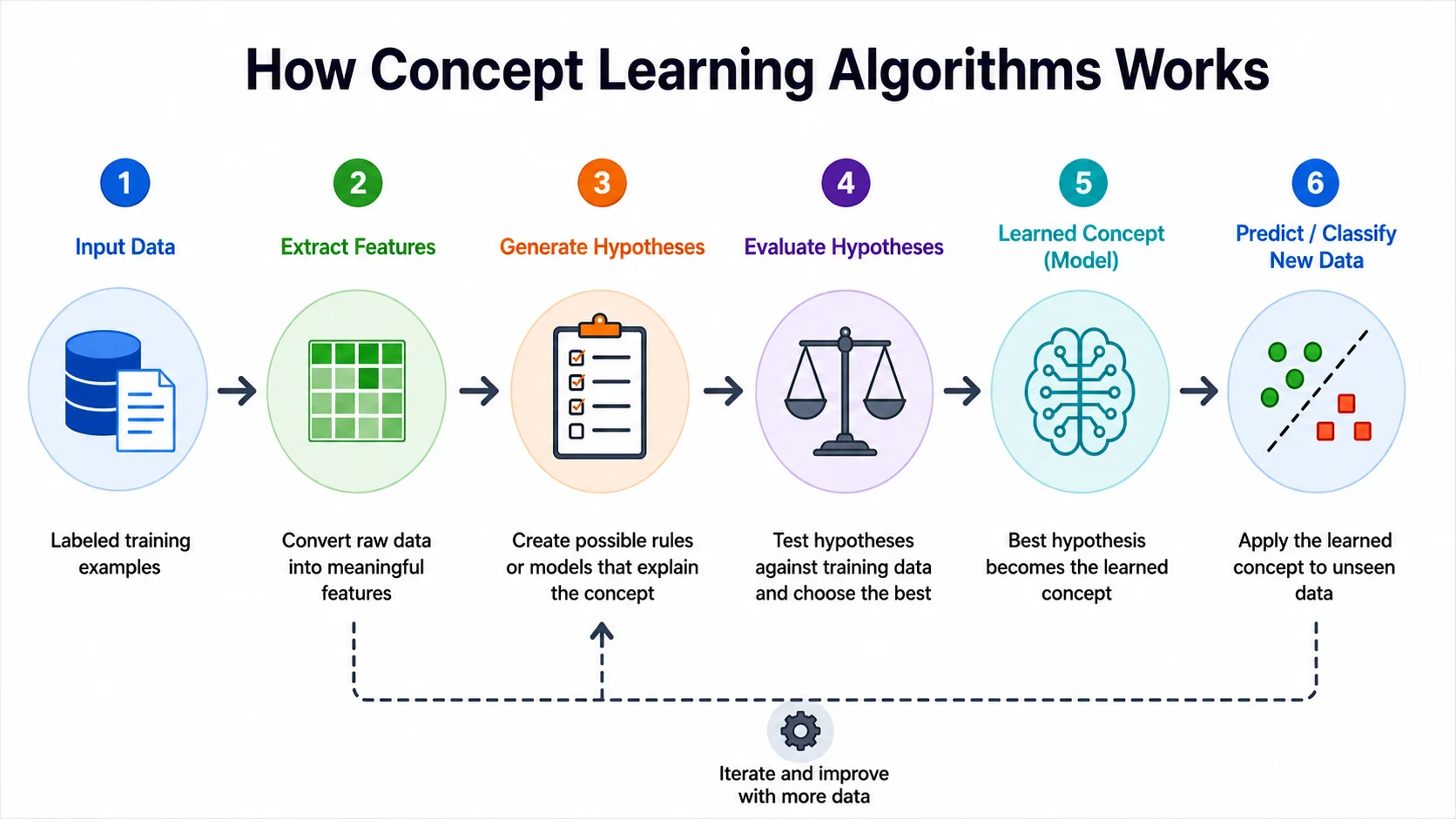
Concept learning follows a process in which a machine studies examples and develops a rule based on their features.
Here are the basic steps:
1. Collect Training Data
The first step is collecting examples that contain useful information. These examples should include relevant features and their correct labels.
2. Identify Attributes
Attributes are the features that describe each example. They help the machine understand the differences between different types of data.
3. Create a Hypothesis
A hypothesis is a possible rule that the machine develops after studying the available examples.
4. Test the Hypothesis
The machine checks whether its rule matches the training examples. If the rule does not match, it needs to be updated.
5. Develop a Final Concept
After examining the examples, the learner identifies a hypothesis that is consistent with the available training data.
Important Terms Used in Concept Learning
Before understanding concept learning algorithms, students should know some basic terms.
Instance: A single example or data record used during learning.
Attributes: The features or properties that describe an instance.
Target Concept: The particular category or idea that the machine needs to learn.
Hypothesis: A possible rule used to identify whether an example belongs to the target concept.
Hypothesis Space: The collection of possible hypotheses that the learning algorithm can consider.
Training Examples: The labelled examples provided to the learning system.
Version Space: The collection of hypotheses that remain consistent with the training examples.
These terms help explain how a machine moves from individual examples towards a general rule.
Popular Concept Learning Algorithms
Two important algorithms commonly taught in concept learning are Find-S and Candidate Elimination.
1. Find-S Algorithm
The Find-S algorithm is used to find the most specific hypothesis that is consistent with all positive training examples.
It starts with a very specific hypothesis and gradually makes it more general whenever it encounters a positive example that does not match.
How Find-S works:
Start with the most specific possible hypothesis.
Read the training examples one by one.
Ignore negative examples.
Compare each positive example with the current hypothesis.
Generalise the hypothesis wherever necessary.
Return the final hypothesis.
2. Candidate Elimination Algorithm
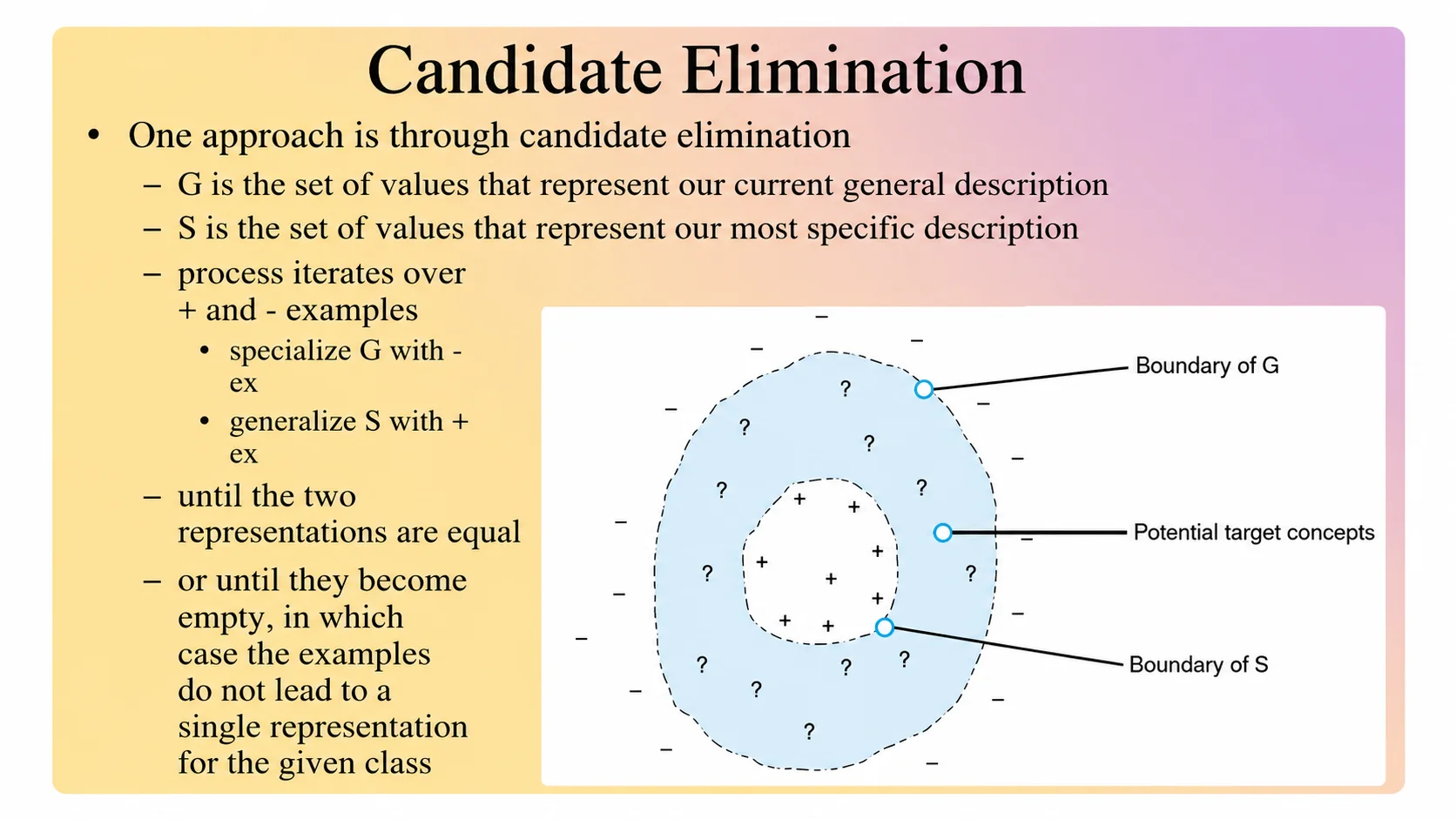
The Candidate Elimination algorithm is another important concept learning algorithm. Unlike Find-S, it considers both positive and negative training examples.
Its main purpose is to maintain all hypotheses that remain consistent with the available training data.
It works with two boundaries:
Specific Boundary (S): Represents the most specific hypotheses that remain consistent with the examples.
General Boundary (G): Represents the most general hypotheses that remain consistent with the examples.
The algorithm updates these boundaries whenever it receives a new training example.
When it receives a positive example, it generalises the specific boundary. When it receives a negative example, it specialises the general boundary.
Find-S vs Candidate Elimination
| Find-S | Candidate Elimination |
|---|---|
| Uses positive examples | Uses positive and negative examples |
| Finds one specific hypothesis | Maintains a set of consistent hypotheses |
| Does not maintain version-space boundaries | Maintains S and G boundaries |
| Simpler to understand | More detailed learning process |
Both algorithms are useful for understanding how machines learn rules from examples. However, they are mainly foundational learning algorithms rather than the standard tools used for every modern machine learning project.
Practical Example of Concept Learning
Let's understand concept learning through an everyday example.
Suppose a computer needs to learn whether a student is eligible for a particular training programme based on three conditions:
Age
Educational qualification
Basic computer knowledge
The machine receives labelled training records showing whether previous applicants were eligible or not.
After studying the examples, it tries to identify common conditions among eligible applicants.
For example, it may discover that applicants meeting a particular age requirement, having the required qualification and possessing basic computer knowledge are more likely to satisfy the eligibility rule.
The machine then uses its learned hypothesis to evaluate new records.
This simple example demonstrates how concept learning uses existing information to develop a rule that can be applied to new data. In a real system, the result would depend on the actual eligibility criteria and the quality of the training data.
Applications of Concept Learning
Concept learning provides a foundation for understanding how machines identify categories and learn from labelled information.
Some areas where these ideas are useful include:
1. Email Classification: Learning patterns that help distinguish unwanted emails from normal messages.
2. Healthcare: Understanding how patient features and labelled medical records can support classification tasks.
3. Customer Classification: Identifying groups of customers based on their characteristics and behaviour.
4. Fraud Detection: Learning patterns associated with suspicious financial activities.
5. Image Recognition: Understanding how features can help a computer distinguish between different image categories.
Modern applications generally use more advanced models and methods, but the basic idea of learning from labelled examples remains important.
Benefits and Limitations of Concept Learning
Concept learning helps students understand how machine learning systems develop rules from training data.
Benefits:
Makes the basics of supervised learning easier to understand.
Explains how machines generalise from examples.
Introduces important ideas such as hypotheses and version spaces.
Builds a foundation for understanding classification algorithms.
Limitations:
The quality of learning depends on the quality of training data.
Incorrect labels can affect the learned hypothesis.
A limited hypothesis space may not represent the actual target concept.
Basic algorithms such as Find-S do not handle uncertainty in the same way as Candidate Elimination.
Understanding these limitations helps students avoid assuming that every machine learning algorithm works perfectly in every situation.
Career Opportunities After Learning Machine Learning
Concept learning itself is not a separate job qualification. However, understanding its principles can help students develop the foundation needed for more advanced machine learning skills.
With programming knowledge, mathematics, statistics, practical projects and experience with machine learning tools, learners can explore several career paths.
Some popular roles include:
1. Machine Learning Engineer: Develops and improves machine learning models for practical applications.
2. Data Scientist: Studies data, identifies patterns and uses analytical methods to support business decisions.
3. AI Engineer: Works on intelligent applications using machine learning and other AI technologies.
4. Data Analyst: Collects, processes and studies data to find useful information.
5. Research Assistant in AI/ML: Supports research activities involving algorithms, experiments and machine learning models.
The opportunities and eligibility requirements vary according to the organisation and job role. Students should focus on developing practical skills rather than relying only on theoretical knowledge.
Skills Required to Build a Career in Machine Learning
If you want to enter the machine learning field, start by building a strong technical foundation.
Here are some useful skills:
Python Programming: Learn variables, functions, loops and libraries used for data processing.
Mathematics: Understand basic statistics, probability and linear algebra.
Data Handling: Learn how to collect, clean and organise datasets.
Machine Learning Algorithms: Study classification, regression, clustering and other important methods.
Machine Learning Libraries: Explore tools such as NumPy, Pandas and Scikit-learn.
Practical Projects: Apply your knowledge by developing and testing small machine learning projects.
Regular practice and a portfolio of completed projects can help demonstrate your abilities to potential employers.
How Can Emancipation Edutech Help You Learn Machine Learning?
If you want to develop your knowledge of artificial intelligence and machine learning, choosing a structured learning programme can help you follow the right learning path.
Emancipation Edutech, Ranchi, offers a Machine Learning and AI course designed to cover important technical concepts and practical learning areas. Choose the right training institute in Ranchi
The programme's published curriculum includes:
Python programming and machine learning fundamentals.
Supervised and unsupervised learning.
Algorithms such as Decision Trees, Random Forest, KNN and Naive Bayes.
Data preparation and model evaluation.
Introduction to deep learning and generative AI.
Practical machine learning projects.
Model deployment and portfolio development.
Students can explore the Machine Learning Course in Ranchi to understand the published curriculum and course details.
Whether you are a college student, graduate or aspiring technology professional, building your knowledge step by step can help you prepare for future opportunities in the AI and machine learning industry.
Conclusion
Concept learning in machine learning is an important foundation for understanding how computers learn rules from examples. It introduces essential ideas such as hypotheses, hypothesis spaces, version spaces and learning algorithms.
Find-S and Candidate Elimination help explain how a machine can develop and refine a concept using training data. Although modern machine learning uses many advanced algorithms, these foundational ideas remain valuable for students who want to understand the learning process.
If you are planning to build a career in artificial intelligence or machine learning, start with programming, mathematics and basic algorithms. Continue with practical projects and structured learning to develop skills that can support your career journey.
Frequently Asked Questions (FAQs)
1. What is concept learning in machine learning?
Concept learning is the process of teaching a machine to identify a particular category or concept by studying labelled examples and developing a general rule.
2. Which algorithms are used in concept learning?
Find-S and Candidate Elimination are two important algorithms used to understand concept learning. They help explain how hypotheses are created, generalised and refined.
3. What is the difference between Find-S and Candidate Elimination?
Find-S uses only positive examples to find a specific hypothesis, whereas Candidate Elimination uses both positive and negative examples to maintain a range of consistent hypotheses.
4. Is concept learning important for beginners?
Yes. It helps beginners understand important machine learning ideas, including training data, hypotheses, generalisation and classification.
5. What career opportunities are available after learning machine learning?
Learners with the required programming, mathematical and practical skills can explore roles such as Machine Learning Engineer, Data Scientist, AI Engineer and Data Analyst. The required qualifications and experience vary by role.
For More Information and Updates, Connect With Us
- Phone Number: +919264477176, +917488456170
- Blogs: https://emancipation.in/blog
- Our Platforms:
- YouTube: https://www.youtube.com/@Emancipation.Edutech
Live Emancipation: https://live.emancipation.co.in
- Follow Us on Social Media:
- Instagram - https://www.instagram.com/teamemancipation/
- Facebook - https://www.facebook.com/teamemancipation/
- Connect on Linkedin: https://in.linkedin.com/school/emancipation/